












We can finally celebrate the end of winter and a new beginning when spring comes. However, the end of winter was not that gloomy, especially for those who work with Shopify. February brought a wide mix of operational updates across Shopify.
The latest Shopify changelog feels less experimental and more structural. It touches POS, payments, analytics, bundles, VAT, and shipping. Let's go through everything that changed very quickly:
Legacy customer accounts are phased out and migration is now a priority
POS editor enhancements support lock and customer display separation
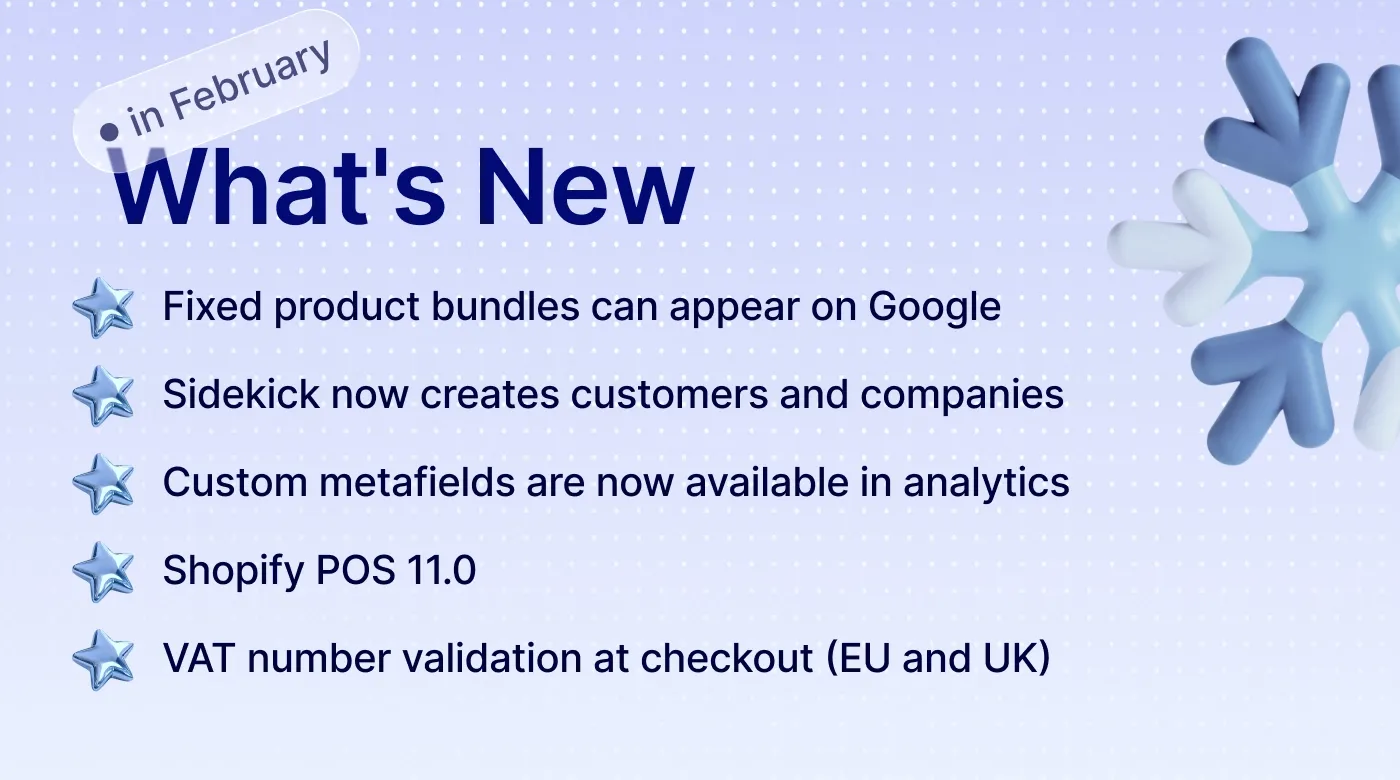
Fixed product bundles can appear on Google
Set bundles with fixed components can now be published on Google. This includes Google Search, Shopping ads, and YouTube placements. Bundles created using Shopify's native bundling tool or via API qualify. Merchants simply enable Google and YouTube publishing in the product settings. Pricing, inventory, and images sync automatically. This expands visibility for curated product combinations without additional setup.
Read our article if you want to know more about Shopify bundling - How to create bundles on Shopify.
Sidekick now creates customers and companies for merchants
Shopify's AI assistant can now create customer profiles and B2B companies through natural language prompts. Instead of filling out forms manually, merchants just describe what they need.
For example, creating a VIP customer or setting up a B2B company with specific payment terms can now be done conversationally. Any field from the standard creation form can be populated this way. This reduces repetitive admin work, especially for B2B operations.
Custom metafields are now available in analytics
Metafields can now be used as dimensions and filters in Shopify Analytics. Merchants can segment reports by custom data, such as:
Material type
Ingredient
Loyalty tier
Internal product tags
After enabling "Use in Analytics" inside metafield settings, the data becomes available in Reports and Explore. This removes the need to export information into spreadsheets for deeper segmentation.
Shopify POS 11.0 brings a faster checkout experience
New version introduces structural improvements to the cart and checkout experience. The cart layout is cleaner and easier to scan. Staff can now select multiple items at once to edit them in bulk. Contextual actions are placed closer to where they are used, reducing unnecessary navigation.
Checkout flow remains visually consistent from cart to payment. Payment selection is faster and clearer. Larger number pads improve split payments and cash handling. Customer assignment also includes better matching and autofill logic, reducing duplicate profiles.
Performance improvements were applied across search, product selection, and cart building. The overall experience is more stable during busy hours.
VAT Number validation at checkout simplifies EU and UK B2B
Merchants using Shopify Tax in the EU or UK can now enable VAT number validation at checkout. When eligible, the reverse charge mechanism applies automatically, and VAT is removed from the order.
Validation happens in real time. VAT numbers are stored in customer profiles for future use. Eligibility depends on the fulfillment location country, not the store address. This simplifies cross-border B2B compliance within Europe.
Updated capital repayment collection in Texas
Due to regulatory adjustments in Texas, financing issued after September 1, 2025, is now repaid through Shopify Payments. Repayment amounts are deducted from daily payouts before funds are deposited into the merchant's bank account.
Financing agreements created before that date continue using ACH direct debit. This change only applies to new funding agreements.
Legacy customer accounts are phased out and migration is now a priority
Older customer account versions are no longer available to new stores and will stop receiving feature updates. A final date will be announced later in 2026. The newer account system includes:
Passwordless login
Built-in store credit
Native return flows
B2B functionality
App block customization
Migration is strongly recommended to access ongoing improvements.
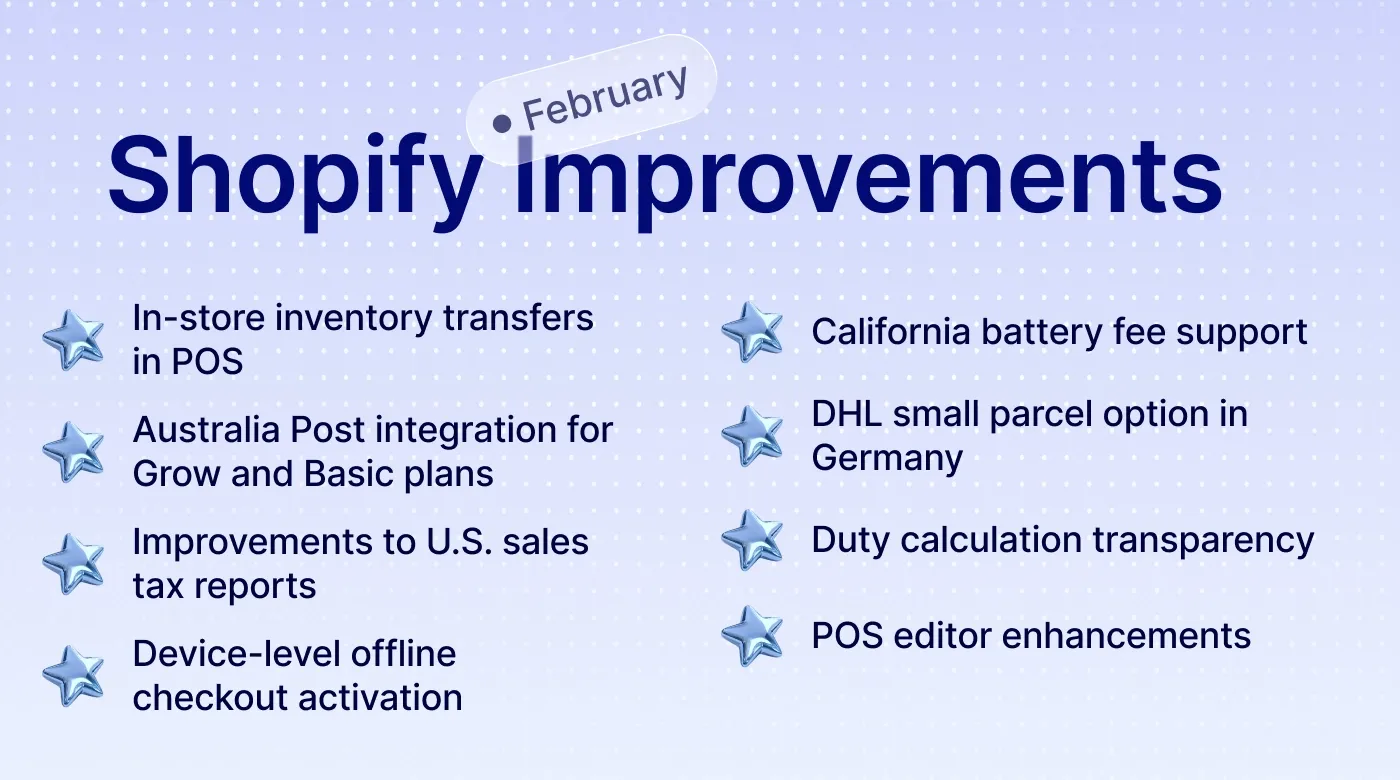
In-store inventory transfers now built into POS
Shopify POS version 10.20 introduces a native inventory transfer workflow directly on POS devices. Retail staff can now send and receive stock between locations without switching to the admin or using third-party apps.
Outgoing transfers are handled inside the Orders section, where staff can pick, pack, and dispatch shipments. Incoming transfers are verified in the Products section. Items can be scanned to confirm quantities, and transfer statuses update in real time within Shopify’s inventory system.
Permissions can be assigned per staff member, and everything is logged for reporting and auditing. For multi-location retailers, this reduces stock discrepancies and improves traceability across stores.
Australia Post integration for Grow and Basic plans
Australian merchants on Grow and Basic plans can now connect their Australia Post account at no additional cost. Once linked, labels can be purchased directly in the Shopify admin using the existing MyPost Business rates.
Tracking numbers sync automatically to orders. This simplifies domestic and international shipping without requiring external tools.
Improvements to U.S. sales tax reports for business owners
Two U.S. sales tax reports received updates. The detailed transactions report now includes full origin, destination, and billing addresses. Product categories and tax exemptions are also clearly displayed.
The jurisdiction report now separates item totals from shipping totals correctly and includes new combined summary columns. A previous calculation inconsistency was corrected. These changes improve accuracy for filing and audits.
Device-level offline checkout activation
Offline checkout can now be enabled per POS device with proper permissions. Despite connectivity stability, staff can continue processing sales. All activations are logged in the store activity history. Card payments require offline payment settings to be enabled beforehand. This ensures business continuity during network outages.
California embedded battery fee support
Starting March 12, 2026, Shopify Tax will automatically calculate and collect California's embedded battery recycling fee on eligible products shipped to the state. The fee applies to certain electronics that are not designed for easy battery removal. Product categorization must be accurate for proper application.
Merchants can also customize tax line breakdowns in order confirmation emails through template adjustments.
DHL small parcel option in Germany
DHL Kleinpaket is now available when purchasing shipping labels in the Shopify admin. It supports small parcels up to 1 kg, with specific dimension limits. This option is suited for small accessories and lightweight goods, offering affordable domestic shipping through DHL's network.
Duty calculation transparency
Merchants using Shopify's duties and import tax features can now see detailed breakdowns directly on the order page. Rates and tariff calculations are visible for cross-border orders. This improves clarity when explaining charges to customers and verifying compliance.
POS editor enhancements support lock and customer display separation
Smart Grid tiles in the POS editor can now be edited instead of deleted and recreated. Assigned products and fee values can be adjusted directly.
Lock screen and customer display settings are now separated into clearer layout sections. Backgrounds, logos, and colors can be customized more easily across devices. This reduces configuration time for multi-location retail setups.
Shopify now supports payment collection per fulfillment
Shopify now supports payment collection per fulfillment. This is especially useful for pre-orders, custom products, and orders with mixed availability.
Instead of charging the full order upfront, merchants can request payment when each shipment is ready. Customers receive these requests in their account or via email links. All transactions are tracked directly in the Shopify admin. This removes the need to manually manage partial payments and helps merchants improve money flow without extra bookkeeping.
Automatic locking of staff cards
Account owners can now set automatic expiration dates for staff Balance or Credit cards. Once the selected date is reached, the card locks automatically. This adds better spending control and reduces risk when issuing temporary cards for employees or contractors.
These updates will reward merchants who configure them properly. If you're planning Shopify web development, Shopify migration, POS workflows refinement, or Shopify B2B development and logic implementation, contact DigitalSuits, and we can help.
Our team is a certified Shopify partner that works with complex ecosystems – from performance upgrades to compliance configuration and Shopify Plus development.

Written by
Yurii Zablotskyi
Content Marketing Specialist
Yurii Zablotskyi is a passionate content writer and storyteller with a strong marketing background, focusing on marketing, sales, and technology, turning complex ideas into valuable content.













Was this helpful?
0
No comments yet