












The right ecommerce platform is one of the decisions that can affect almost everything that comes next in your online business. In 2026, it also feels harder to get right. Both Shopify and Wix have evolved. AI tools are now part of the game, and pricing can look very different once you move past the basic plans.
In this article, DigitalSuits compares Wix and Shopify across different industries to help you decide which platform is better for building an online store. In general, Shopify has a stronger commerce reputation, but Wix is no longer just a website builder with a checkout page. Based on what you sell, how much freedom you require, and where you see the firm going next, either choice may make sense.
Our Shopify vs Wix for ecommerce comparison examines the key differences in 2026. Not the usual platform wow features, but the practical stuff that affects daily operations and future growth.
Fast facts of the Wix vs Shopify comparison
Here is the short version of Shopify vs. Wix comparison:
Shopify is built around commerce. It makes more sense for stores that need stronger selling tools and more room to expand. That becomes more noticeable as the catalog grows and operations become more complex. The trade-off is that Shopify can get expensive once you move beyond the basics.
Wix is simpler in comparison. It began as a platform for building websites, and that still shows. For brands with lighter ecommerce needs, that may not be a weakness at all. It can be easier to manage and less dependent on outside apps.
To help you understand quickly:
If you primarily sell things in bulk or anticipate quick expansion, Shopify's infrastructure pays for itself.
If you operate a tiny or hybrid business (like services with a small shop), Wix offers higher value per dollar at the basic level.
Difference between Wix and Shopify side by side
Both systems debuted in 2006, but with completely distinct DNA. The table below compares the two platforms on the most important aspects.
| Aspect | Shopify | Wix |
|---|---|---|
| Founded/Focus | 2006, ecommerce-first | 2006, website builder + ecommerce |
| Ease of setup | Guided, slightly steeper curve | Drag-and-drop, faster first launch |
| Design flexibility | Block-based themes, 200+ options, most paid ($100-$500) | Pixel-level freedom, 900+ free templates |
| Ecommerce features | Advanced: inventory, multi-channel, automation | Solid for small stores; limited automation |
| Growth and store capacity | Scales to enterprise (Shopify Plus) | Good for SMBs; ceilings at high volume |
| Cost, payments, and extra charges | $29/mo (Basic, annual). Extras: 0% with Shopify Payments; 0.5% - 2% with 3rd-party | $29/mo (Core, annual). Extras: None on any plan |
| App ecosystems | 16,000+ apps | 800+ apps |
| Built-in marketing / SEO | Strong SEO infra; requires apps for email marketing | Native email marketing; improved SEO toolkit |
| Support, help, and community | 24/7 chat, email, phone on all plans | 24/7 chat and email; phone on top tiers |
| AI tools | Shopify Magic (descriptions, images, summaries), Shopify Sidekick (AI assistant) | Wix AI site builder, AI chatbot, and content generation |
What is better – Wix or Shopify – for an easy setup?
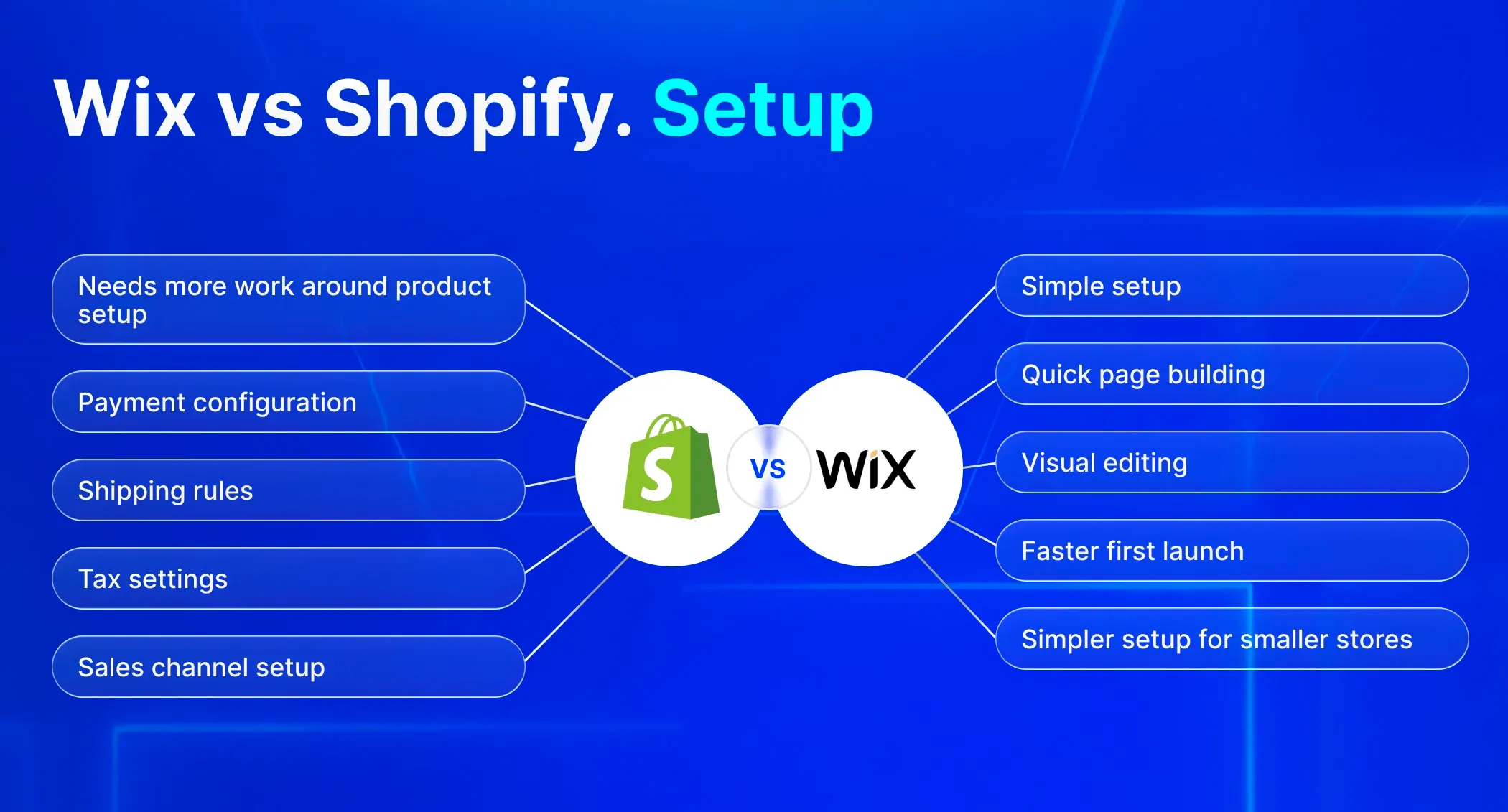
For a simple setup, Wix is usually easier. It requires less from the user at the outset. You can develop pages faster, move pieces around more easily, and get the site in good condition without wasting much effort on the backend. This makes it more accessible to small businesses, solitary creators, and anybody looking to start without turning setup into a lifelong project.
Wix is often easier for:
quick page building
visual editing
faster first launch
simpler setup for smaller stores
Shopify takes more time in the beginning. The process is more structured, and that shows quite early. You are not only building pages. You are also setting up the store logic behind them, which means more attention to the operational side from the start.
Shopify usually involves more work around:
product setup
payment configuration
shipping rules
tax settings
sales channel setup
That extra structure is also why many merchants stay with it as the business grows. What feels slower on day one can make daily management easier later, especially once the store becomes more demanding.
In a Shopify vs Wix comparison, this is one of the clearest differences. Wix is usually easier to start with. Shopify usually asks for more setup, but it creates a stronger base for running the store; once more, moving parts are involved.
The difference is fairly simple.
Wix usually feels easier at the start.
Shopify usually feels more structured from the start.
Shopify vs Wix: Design and customization
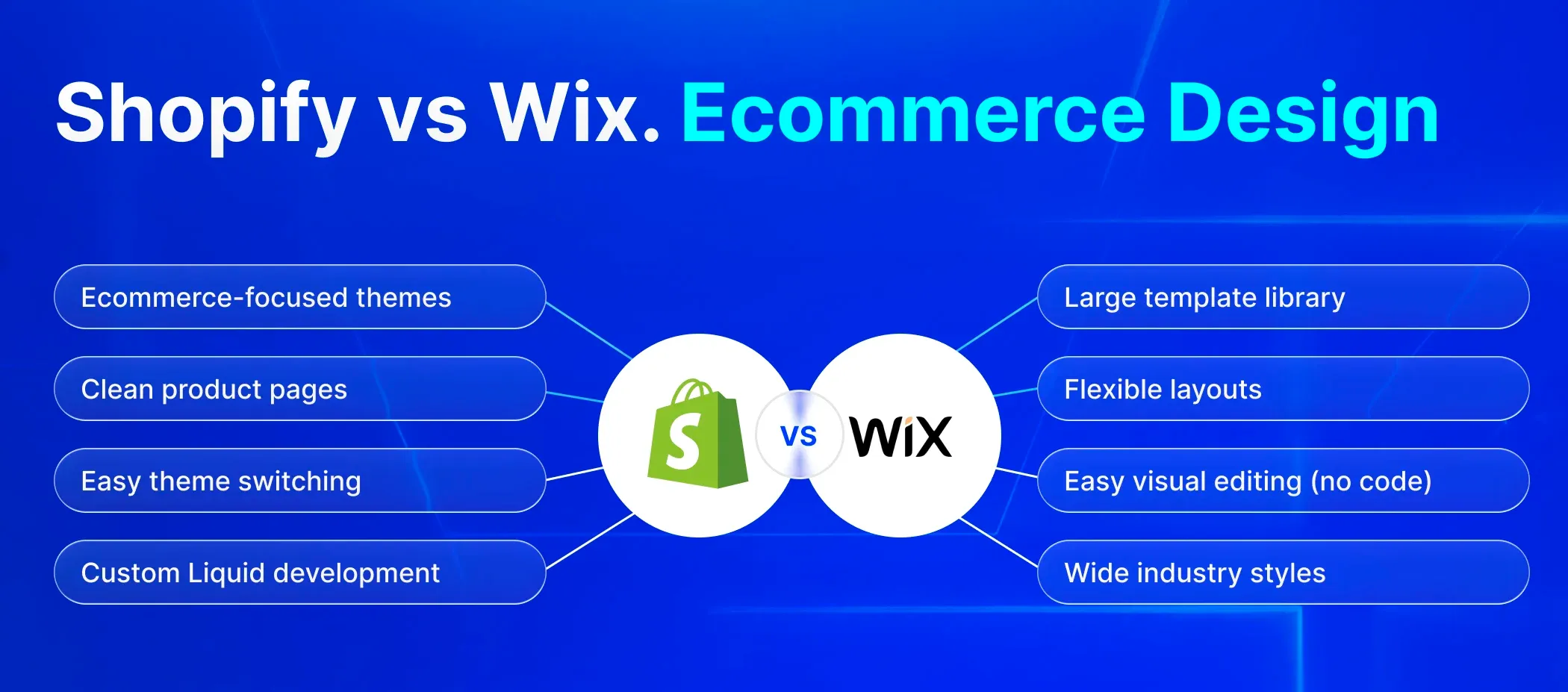
When it comes to UI/UX design, Wix gives users far more freedom from the start. There are hundreds of templates, and the range is wide. You can find layouts for almost any type of business, not just online stores. The editor is also much looser, so moving elements around the page feels closer to traditional website building than store setup.
Wix stands out for:
a large template library
more freedom with layout
easier visual changes without code
broader style variety across different industries
That freedom can be useful, but it also comes with limits. The biggest one is template switching. Once the site is live, moving to a different template is not a smooth process. In many cases, the site has to be rebuilt. That can become a problem when the brand changes or the business outgrows its original look.
Shopify takes a narrower approach. Shopify is stricter in how pages are built. The platform offers its own layouts. However, you may require Shopify theme customization or Shopify theme development services to achieve 100% of your vision. There are fewer themes, and many of the stronger ones are paid. Still, they are built for ecommerce and for product-led brands. The structure is also more stable when the store changes over time.
Shopify is stronger in areas like:
ecommerce-focused theme design
cleaner product page structure
easier theme changes later
deeper custom work through Liquid
That last point matters. Shopify gives developers more room to reshape the storefront if the default theme setup is not enough. For businesses that expect custom work later, that can make a real difference between Wix and Shopify.
Mobile-first design is another part of this comparison. With Wix, desktop and mobile do not always fall neatly into place on their own. Some sections may need extra adjustment on smaller screens. That is less of an issue in Shopify, where themes are usually built with a more consistent responsive structure from the start.
So if you compare Shopify and Wix on design alone, the split is fairly clear.
Wix gives more creative freedom up front.
Shopify gives a more structured theme system that is easier to manage.
Shopify vs Wix for ecommerce: What you get
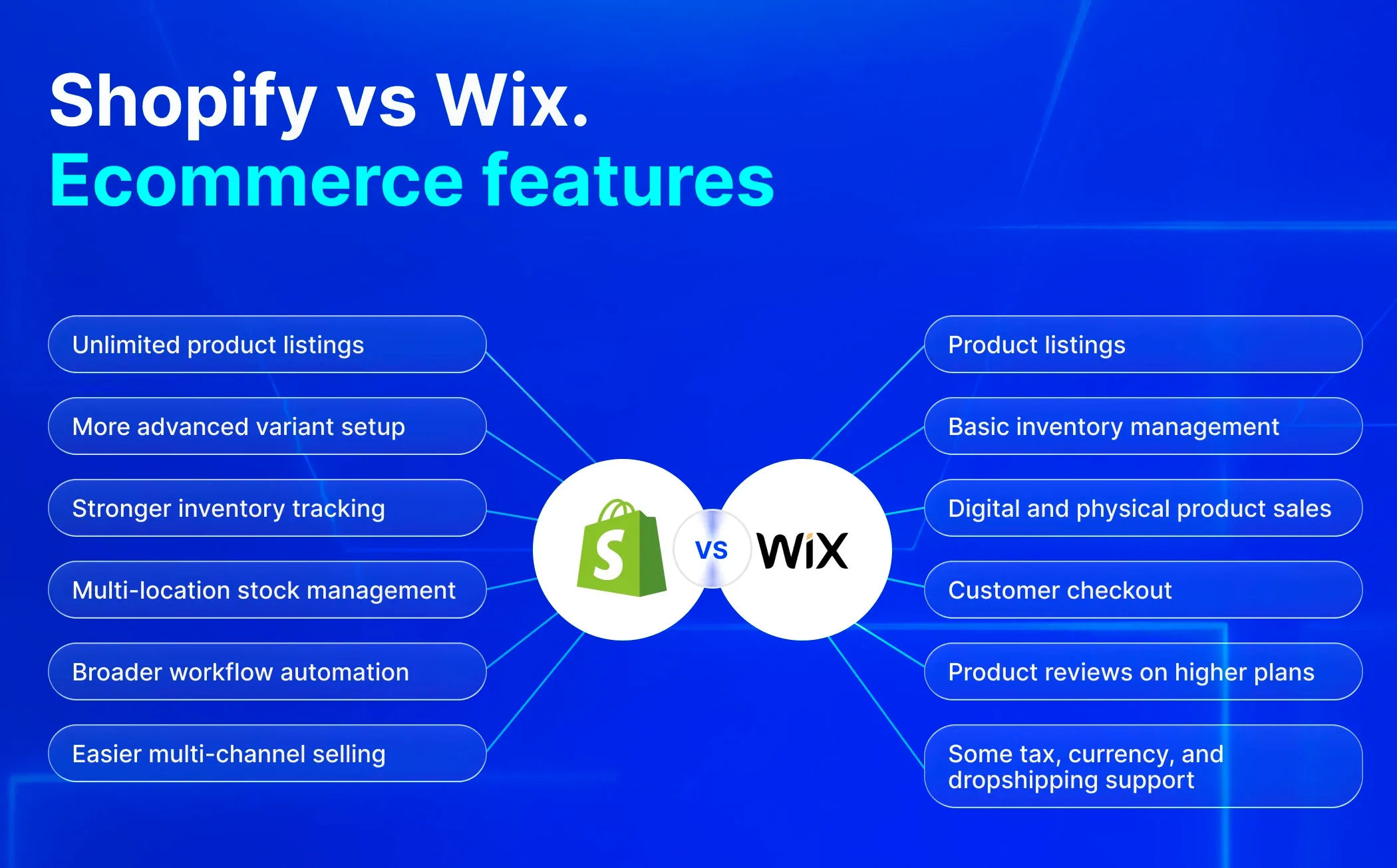
This is usually the point where the gap becomes easier to see.
Shopify is built for businesses that sell as their main activity, not as an extra feature on the site. That shows in the day-to-day store tools. The platform gives merchants more room to manage larger catalogs, more product options, and more complex selling setups without running into limits too early.
Shopify is stronger in areas such as:
unlimited product listings
more advanced variant setup
stronger inventory tracking
multi-location stock management
broader workflow automation
easier multi-channel selling
That matters more once the store starts getting busier. A small catalog is one thing. A store with a lot of products, different variants, several sales channels, and regular order flow is another. Shopify is better prepared for that kind of workload.
Wix covers the basics well enough for many smaller stores. You can sell physical products and digital products, manage inventory, and run a working checkout without much trouble. For businesses with a limited product range and a simpler sales setup, that may be all they need.
Wix usually covers:
product listings
basic inventory management
digital and physical product sales
customer checkout
product reviews on higher plans
some tax, currency, and dropshipping support
Doing business is where the difference between Shopify and Wix becomes more obvious. Wix can handle straightforward ecommerce. Shopify is better suited to stores with more moving parts behind the scenes.
The same goes for selling across other platforms. Shopify is a better setup for businesses that want to connect their store to marketplaces and social channels while keeping stock and orders in sync. Wix can do some of that too, but it usually takes more effort and more patchwork around the edges.
AI for ecommerce is another dividing line. Shopify gives merchants more ways to reduce manual work once the store grows. That includes things like order handling, customer grouping, and fulfillment logic. Wix is more limited there, which may not matter at first, but becomes more noticeable later.
One more thing worth noting is checkout performance. Shopify promotes Shop Pay as a stronger converter than standard checkout, with internal and commissioned data pointing to measurable gains. For larger stores, that is not a small detail. A few extra percentage points at the payment stage can add up quickly.
So when you compare Wix and Shopify on ecommerce features, it's a straightforward division.
Wix works well for smaller and less demanding stores.
Shopify gives merchants more depth, more control, and more room once selling becomes more complex.
Compare Wix and Shopify in growth and store capacity
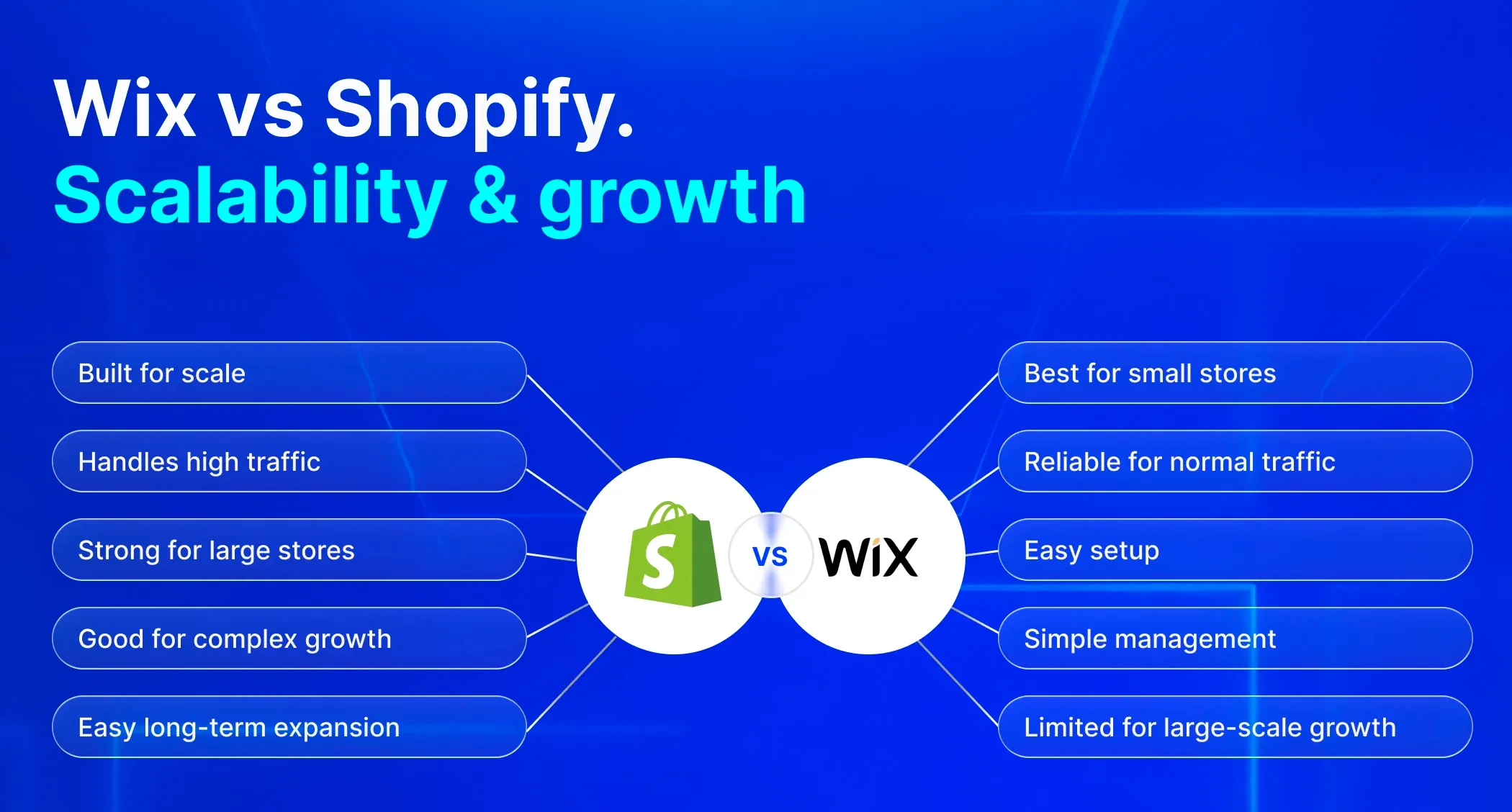
For a typical online store, both platforms handle normal traffic without much drama. Hosting, updates, and server-side maintenance are managed for you on both sides. The difference tends to show later, when the store gets larger, order flow gets heavier, or operations stop being simple.
Shopify has a stronger record here. The platform is designed for merchants who plan to have larger catalogs, increased traffic, and peak sales times. All that will, of course, place a high demand on infrastructure. Shopify emphasizes its success on Black Friday and Cyber Monday 2024, when it processed $11.5 billion in transactions and managed extremely high visitor levels throughout its platform.
That matters more for stores that deal with things like:
fast traffic spikes
larger product ranges
more daily orders
several sales channels running at once
more demanding fulfilment behind the scenes
Wix is also trustworthy, particularly for small and medium-sized organizations. Wix claims 99.99% uptime and describes its hosting as scalable and enterprise-grade. For many firms, that will be sufficient. A local brand, a niche store, or a catalog that stays fairly manageable is unlikely to hit serious limits early on.
Still, the Shopify and Wix gap becomes easier to notice once growth brings more complexity. Wix supposedly offers up to 50,000 goods and 1,000 variants per product; the problem isn't that the platform fails at a low amount. The real question is how comfortable it will feel as the store grows more difficult to handle on a daily basis.
This is usually where Shopify feels better prepared:
higher-volume selling
more operational complexity
stronger support for expansion over time
less friction when the business grows beyond a simple store setup
Wix can still work well at a decent size, but moving to another platform later is rarely a light job. Products can be exported, but the rest usually takes more work than people expect. Payments, apps, design changes, and custom pages often need to be set up again by hand.
So if you compare Shopify and Wix on performance and scalability, the split isn't complicated.
Both can run an online store reliably.
Shopify tends to make more sense for businesses that expect heavier demand or more complexity later.
Wix is often enough for stores that plan to stay leaner and simpler.
Shopify vs Wix: Cost, payments, and extra charges
At first glance, the entry price looks almost the same. Shopify Basic starts at $29/month on annual billing, and Wix Core also starts at $29/month on annual billing. That is where the neat comparison ends.
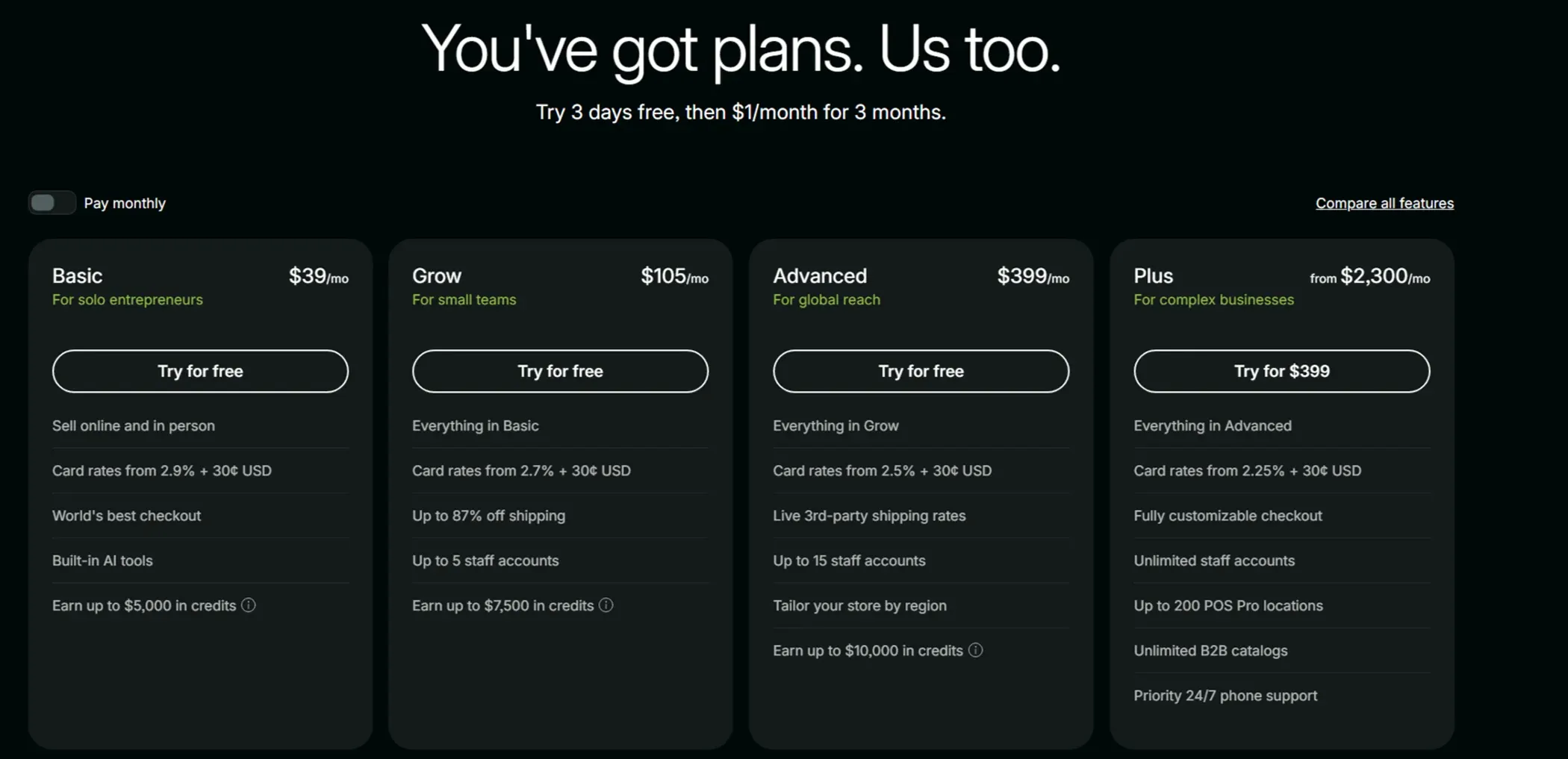
Shopify's paid plans currently break down like this:
Basic - $29/month annually
Grow - $79/month annually
Advanced - $299/month annually
Plus - from $2,300/month on a 3-year term, or $2,500/month on a 1-year term
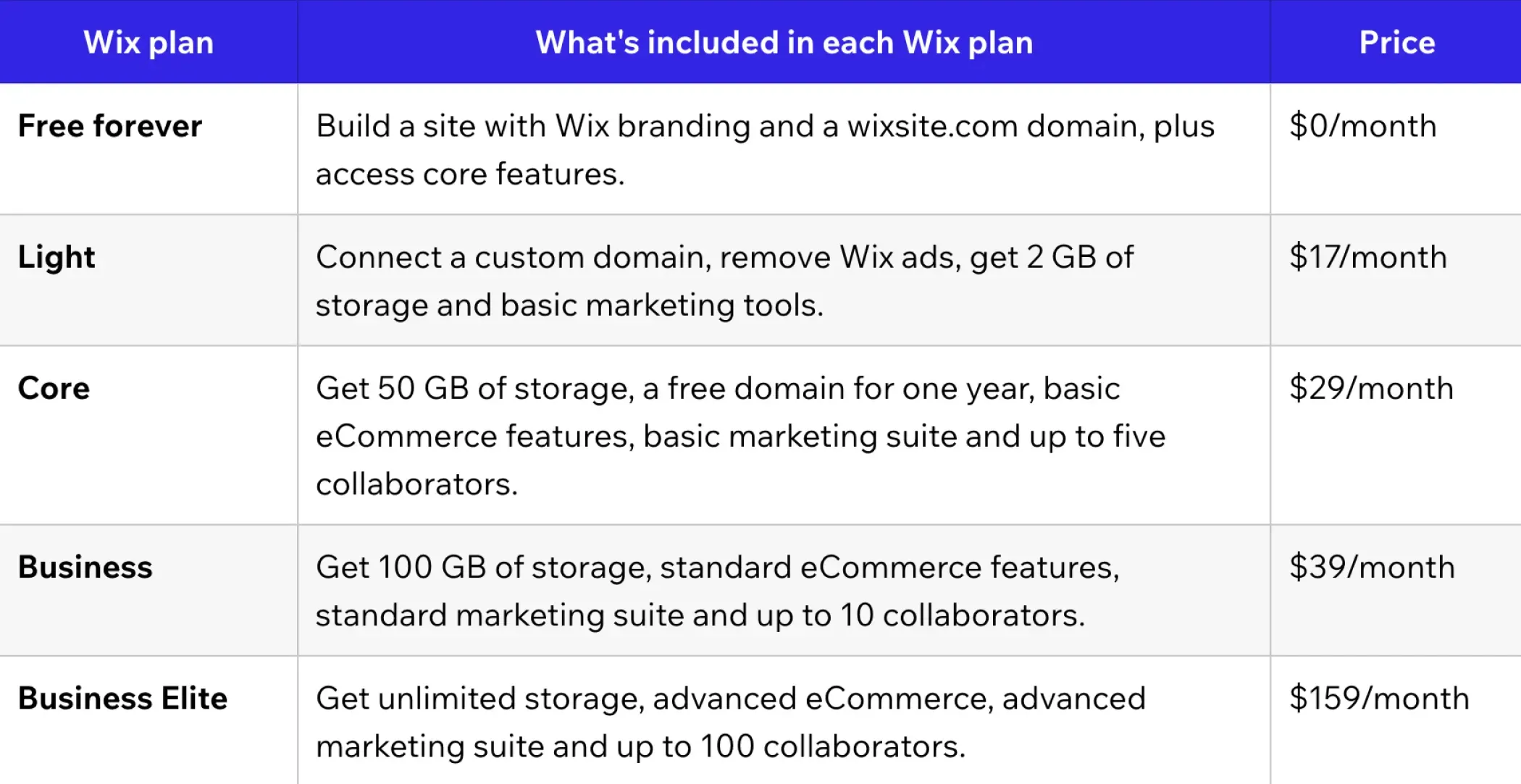
Wix's business plans are simpler:
Core - $29/month
Business - $39/month
Business Elite - $159/month
Light sits below them at $17/month, but it is not for accepting payments online.
The bigger difference is not the plan list. It is what happens after the store starts running. With Shopify pricing, payment costs depend on how you take payments. If you use Shopify Payments, there is no extra Shopify transaction fee. If you use a third-party provider instead, Shopify adds its own fee on top: 2% on Basic, 1% on Grow, and 0.6% on Advanced.
That means Shopify costs are shaped by:
your plan level
whether Shopify Payments is available in your country
whether you need paid apps
how many extra tools the store ends up relying on
Wix is easier to read on this point. Wix says its business plans come with 0% platform transaction fees, so you pay the payment processor rather than an added Wix fee.
That is one reason the Wix vs Shopify for ecommerce cost discussion can look different once real store expenses are on the table. Shopify may start at a similar monthly price, but the total can rise faster when apps and extra fees come into play.
So the main difference is simple.
Shopify gives merchants more depth and more room to build out a serious store, but the monthly total is often less predictable.
Wix is easier to budget for, especially for smaller stores that want fewer moving parts.
That is usually where a Wix and Shopify comparison becomes more practical than theoretical.
Wix and Shopify: App ecosystems
Shopify has a much larger app ecosystem in its Shopify App Store, with more than 16,000 apps.
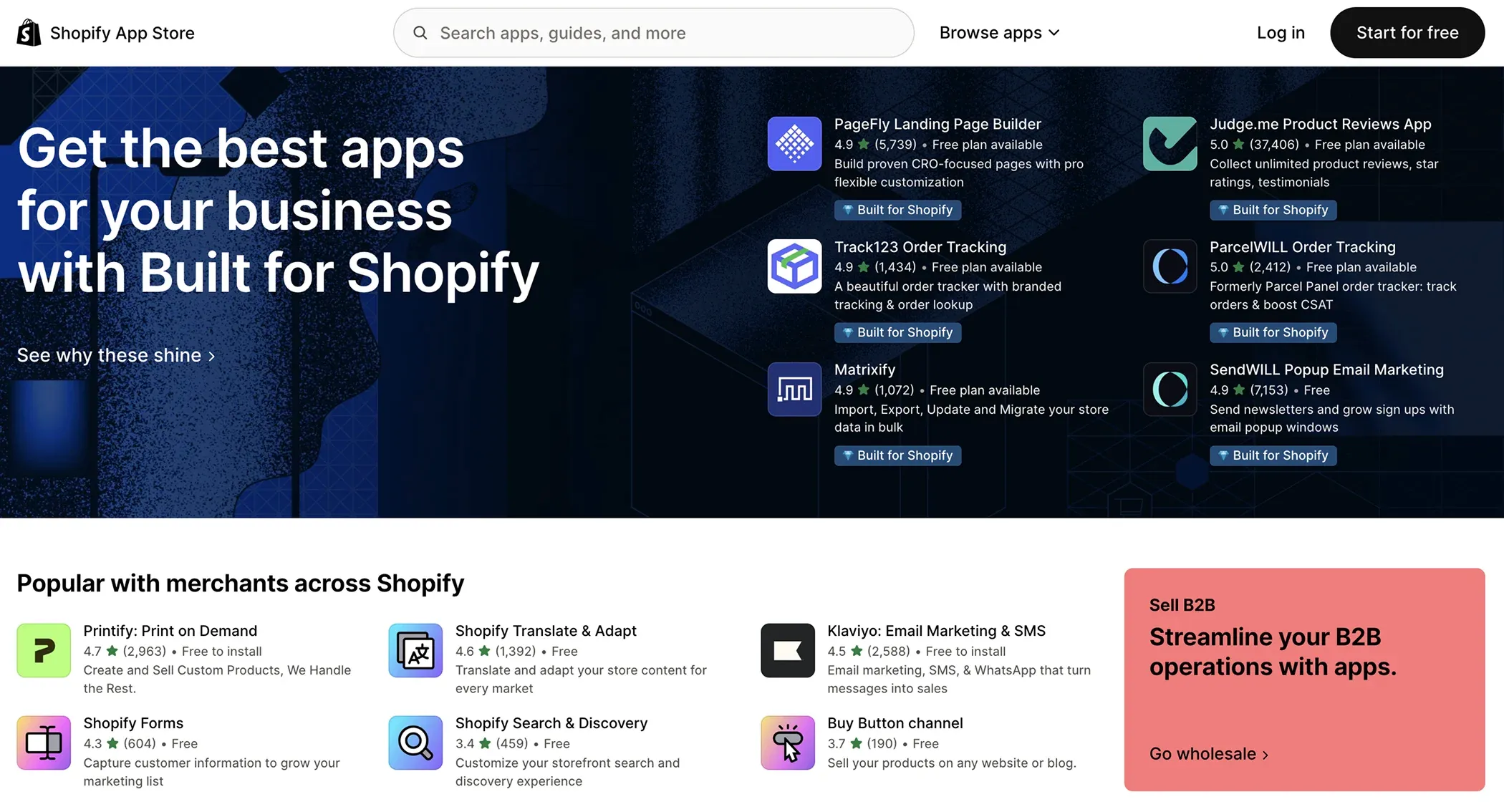
That usually helps with things like:
subscriptions
reviews and loyalty tools
B2B features
AI-driven search, upsells, and recommendations
The upside is choice. The downside is that the choice often turns into extra cost, extra setup, and sometimes extra maintenance. A store with a long app stack can become harder to manage than expected.
Wix takes a different route. Its app marketplace – Wix App Market – is smaller, with over 800 apps.
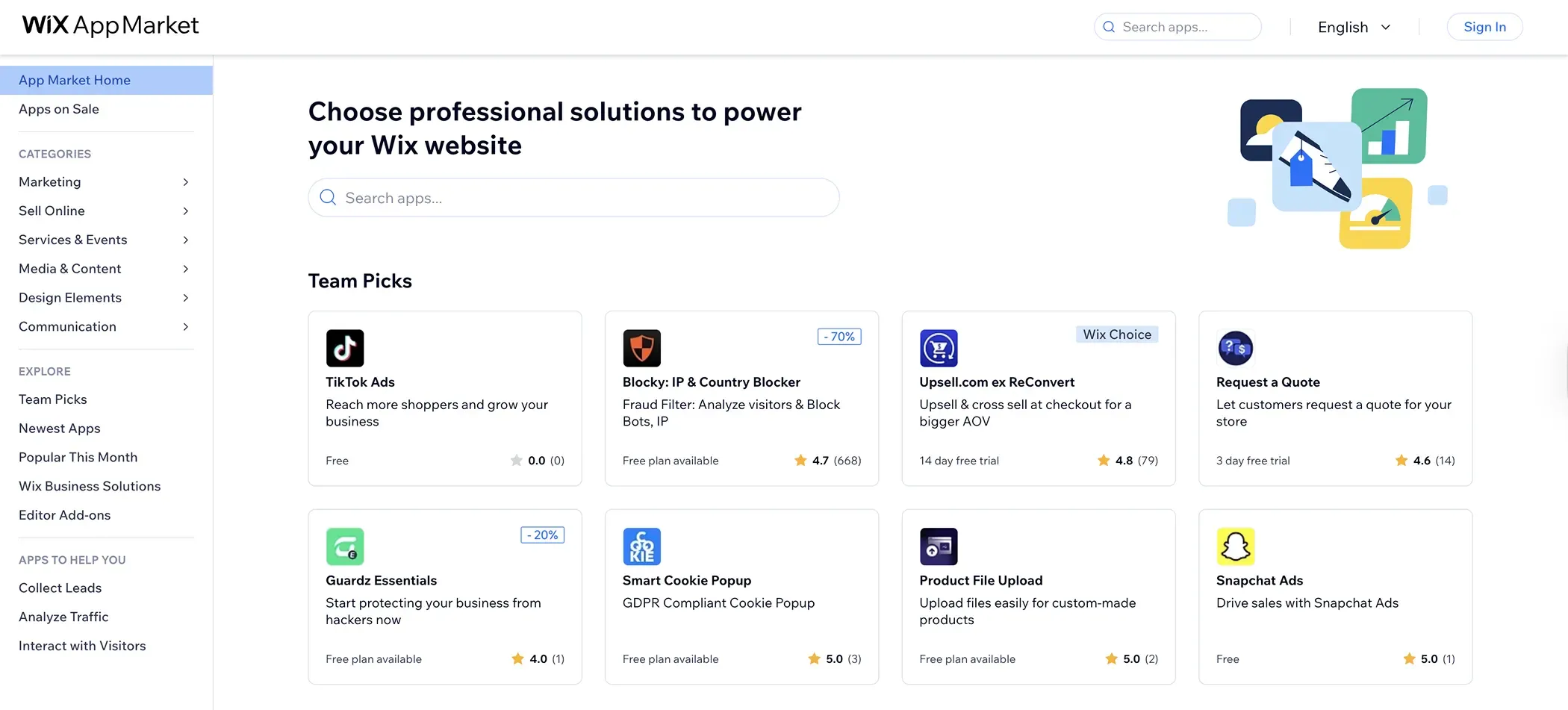
However, Wix includes more business tools within the platform, so merchants do not always need to look for an app straight away. That includes areas such as:
email tools
bookings and scheduling
events
built-in business features tied to the site dashboard
That setup can suit smaller stores, service businesses, or brands that want fewer moving parts behind the scenes.
The difference becomes more obvious when a business depends on outside systems.
Shopify has a deeper integration ecosystem and more established support for ERP, accounting, and CRM. Shopify's own enterprise materials point to direct connections with systems such as NetSuite and Salesforce, and its Help Center documents external integrations for ERP and accounting workflows.
Wix can still connect to external tools through APIs and custom work, but the ecosystem around those integrations is not as broad. For a simple setup, that may not matter. For a business with heavier operational needs, it usually does.
Shopify vs Wix: Store marketing and SEO
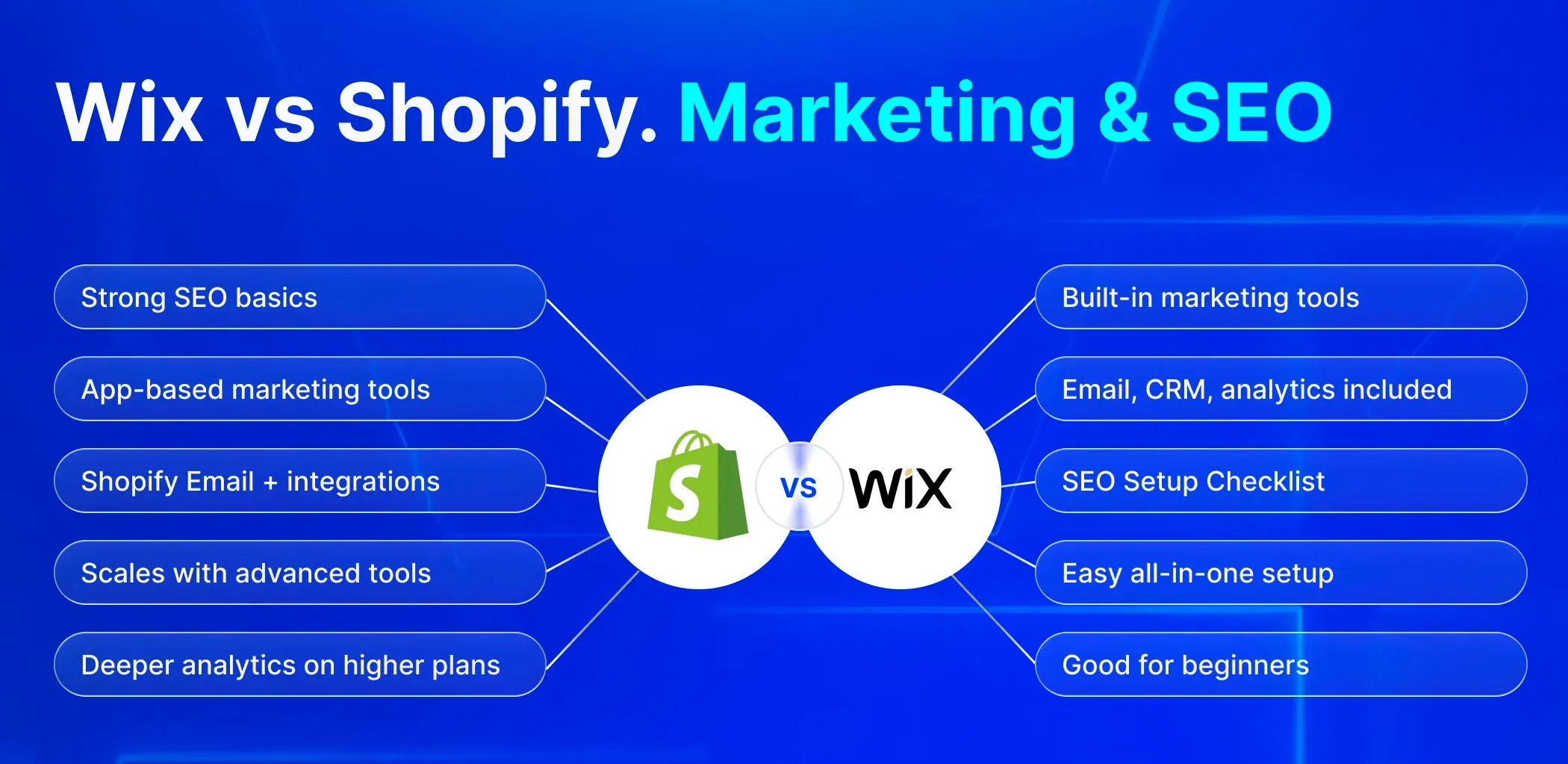
Marketing is one of the areas where both platforms give you a decent starting point, but they do not take the same route.
Wix puts more of those tools inside the platform. Its own materials include:
Email marketing
Analytics
CRM system
SEO tools
It also has the SEO Setup Checklist, which walks users through basics like connecting to Google Search Console and getting pages indexed. That makes Wix easier to work with for people who do not want to build their stores around extra apps from day one.
Wix is especially convenient for things like:
email campaigns
basic customer management
SEO setup guidance
reporting inside the same dashboard
Shopify is different. It gives merchants the core SEO basics you would expect, including sitemap support and a search-friendly store structure. However, a lot of the broader SEO strategy is usually built through integrations or apps. Shopify also offers Shopify Email, while deeper campaign work often happens through tools such as Klaviyo or other third-party platforms. Shopify's analytics capabilities expand by plan tier, with more detailed reporting on higher plans.
Shopify vs Wix: Support, help, and community
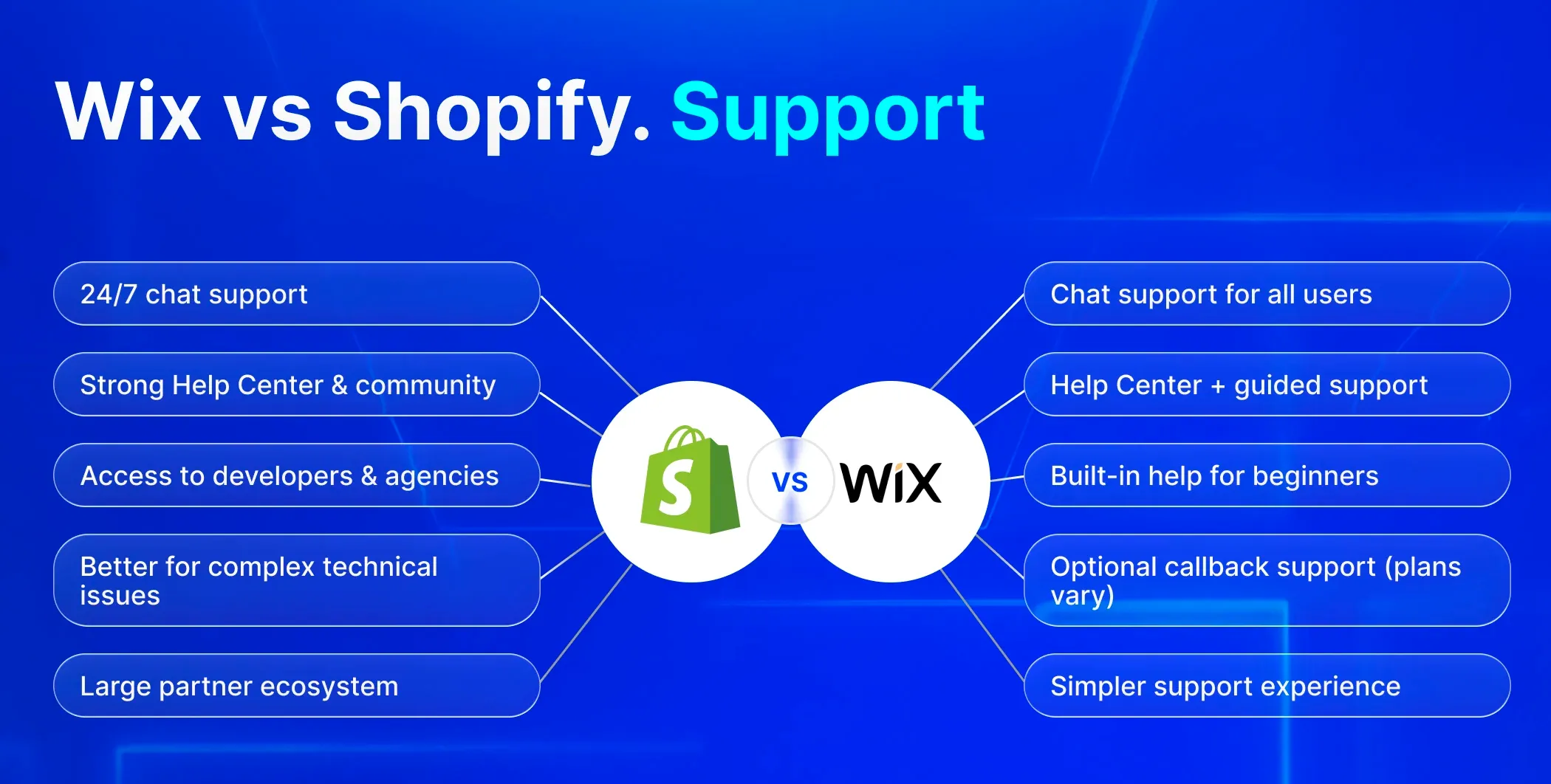
Support looks different on these two platforms, and that can matter more than people expect once something breaks.
Shopify gives all plans 24/7 chat support through its monthly support. Phone and email support are more limited and depend on the plan. Shopify's own support page says phone and email are available for Shopify Plus, while standard plans get 24/7 chat. Shopify also has a large Help Center, an active community forum, and a broad partner network for merchants that need outside technical help.
That setup is useful when the issue goes beyond a basic how-to. A merchant may start with support docs or chat, then bring in a Shopify developer or a Shopify development agency if the job turns into a theme problem, a migration issue, or a custom integration.
Wix is a bit more mixed. Its own support pages say live chat is available to all Wix users, and recent Wix materials also point to callback support alongside chat and Help Center resources.
At the same time, their phone support is reserved for Business Elite and Enterprise in some contexts, so the exact support path can vary by plan or support flow. Its Help Center is solid, and it also offers access to professionals through its marketplace.
So the real difference is not just "who has support." Both do. The difference is in depth around the platform.
Shopify tends to offer more around:
technical help resources
partner and agency support
community knowledge for complex store issues
Wix is often stronger for:
direct help for everyday setup questions
built-in guidance for non-technical users
a simpler support path for smaller sites and stores
How do Wix and Shopify use AI?
AI development now plays a visible role on both platforms, but the focus is different.
In the Wix vs Shopify discussion, Wix stands out more at the setup stage. It uses AI to help users build a site faster, generate content, and get a basic structure in place without starting from a blank page. Its AI tools include:
AI site builder
AI content generation
AI chatbot setup
page and section suggestions
Shopify takes a narrower approach. Its AI tools, like Shopify Sidekick AI assistant, are more focused on store management and content tasks inside an existing ecommerce setup. Its special app - Shopify Magic can help with:
product descriptions
email copy
blog text
FAQs
image edits and generated backgrounds
short summaries and text suggestions in the admin
If the question is Shopify or Wix, this part depends on when you want AI to help.
Wix is more useful when you need help getting started.
Shopify is more useful when the store is already running and needs faster day-to-day content work.
Final thought on Wix vs Shopify for ecommerce
There is no single winner here.
Wix fits smaller, simpler stores and brands that care more about easy site management.
Shopify is good for businesses where selling online is the main focus and growth is part of the strategy.
So, in the Wix vs Shopify choice, the better platform depends on what your business needs now and what it may need next.
If you want expert help with platform choice or migration, DigitalSuits can help.
Frequently asked questions
Can I migrate from Wix to Shopify later without losing my data?
Yes. You can export products from Wix as a CSV file and import them into Shopify. Customer data and order history require more manual effort or a migration tool like Cart2Cart. Page content and custom design elements will not transfer automatically and need to be rebuilt.
Factoring migration time and cost into your initial platform decision is worth doing if you expect to outgrow Wix within 12–18 months. If you need assistance with Wix to Shopify migration or want to know whether it's a necessary step for your business, contact us for expert help.
Does Wix charge transaction fees on sales?
No. Wix charges zero platform transaction fees on any paid plan. You pay only the standard payment processing fees charged by your payment gateway - typically around 2.9% + $0.30 per transaction through Stripe or PayPal. Shopify also waives its platform transaction fee if you use Shopify Payments, but adds 0.5%-2% per transaction when you use a third-party provider.
Which platform is better for dropshipping?
Both support dropshipping. Wix integrates with DSers (formerly AliExpress Dropshipping) on the Business plan and above. Shopify has a broader selection of dropshipping apps, including Zendrop, Spocket, and AutoDS, plus tighter automation for order routing. Merchants running dropshipping as a primary business model at scale generally find Shopify's app depth and multi-supplier automation more capable.
Is Shopify or Wix better for SEO in 2026?
Both platforms support the technical SEO fundamentals: custom meta tags, clean URLs, sitemaps, and SSL.
Wix has improved significantly here, and its built-in SEO Assistant is helpful for beginners. Shopify has an advantage for large product catalogs and complex site architectures where URL structure, canonical tags, and crawl budget management matter more.
For a store under 500 products, the difference in organic visibility between the two is smaller than most comparisons suggest.
What happens to my Wix store if I exceed my plan limits?
Wix will prompt you to upgrade your plan. Storage limits, for example, range from 50GB on Core to unlimited on Business Elite. If you hit the automated sales tax limit (500 transactions per month on the Business plan), you will need to handle tax calculations manually or upgrade. Shopify's standard plans do not impose similar storage or transaction count limits, though you may hit app restrictions at lower tiers.

Written by
Yurii Zablotskyi
Content Marketing Specialist
Yurii Zablotskyi is a passionate content writer and storyteller with a strong marketing background, focusing on marketing, sales, and technology, turning complex ideas into valuable content.












Was this helpful?
0
No comments yet