










If you're planning to sell your products and services to other businesses, a B2B ecommerce platform is your starting point. That's where you can organize and automate your wholesale processes, optimizing your operational budgets. Which B2B platform is the best for your business? This article will help you make an informed decision.
Today, we'll review the most popular ecommerce platforms for B2B businesses:
What is a B2B ecommerce platform?
B2B ecommerce platforms are systems for handling complex wholesale business processes, such as bulk order fulfillment, inventory management, customer management, and financial management. Typically, businesses use B2B ecommerce tools when they need to either add wholesale opportunities to their B2C model or to start a B2B business as a separate entity.
Benefits of B2B ecommerce platforms
To better understand the reasons for using B2B ecommerce platforms, we've compiled a list of the benefits you can get by implementing one into your business infrastructure.
Reduce cost per order. Manual order processing with spreadsheets, numerous emails, and phone calls is time-consuming. Automation of pricing rules, order confirmation, and invoicing that comes with a B2B ecommerce platform significantly reduces time and saves labor costs.
Streamline customer experience: Modern platforms deliver intuitive navigation, smart product search, and personalized catalogs, which convey a sense of convenience, improving retention and brand loyalty.
Provide self-service ordering. B2B ecommerce systems allow buyers to place orders and check inventory in their customer accounts without having to contact a sales rep. This option speeds up decision-making and enables your customers to make purchases outside office hours.
Increase conversions and repeat purchases. B2B buyers appreciate speed and predictability. Features like quick reorders, saved product lists, and bulk ordering help them make purchases in minutes and plan future operations in advance. This makes your buying cycles more efficient, resulting in higher revenue.
Expand reach and scale the business more easily. With proven platforms, you can serve more customers without adding much staff. You don't need to handle every order manually, which improves scalability and ensures sustainable long-term growth.
Key features of B2B ecommerce platforms
The best wholesale ecommerce platforms are equipped with a set of features that make B2B sellers' lives way easier. What are the most important of them?
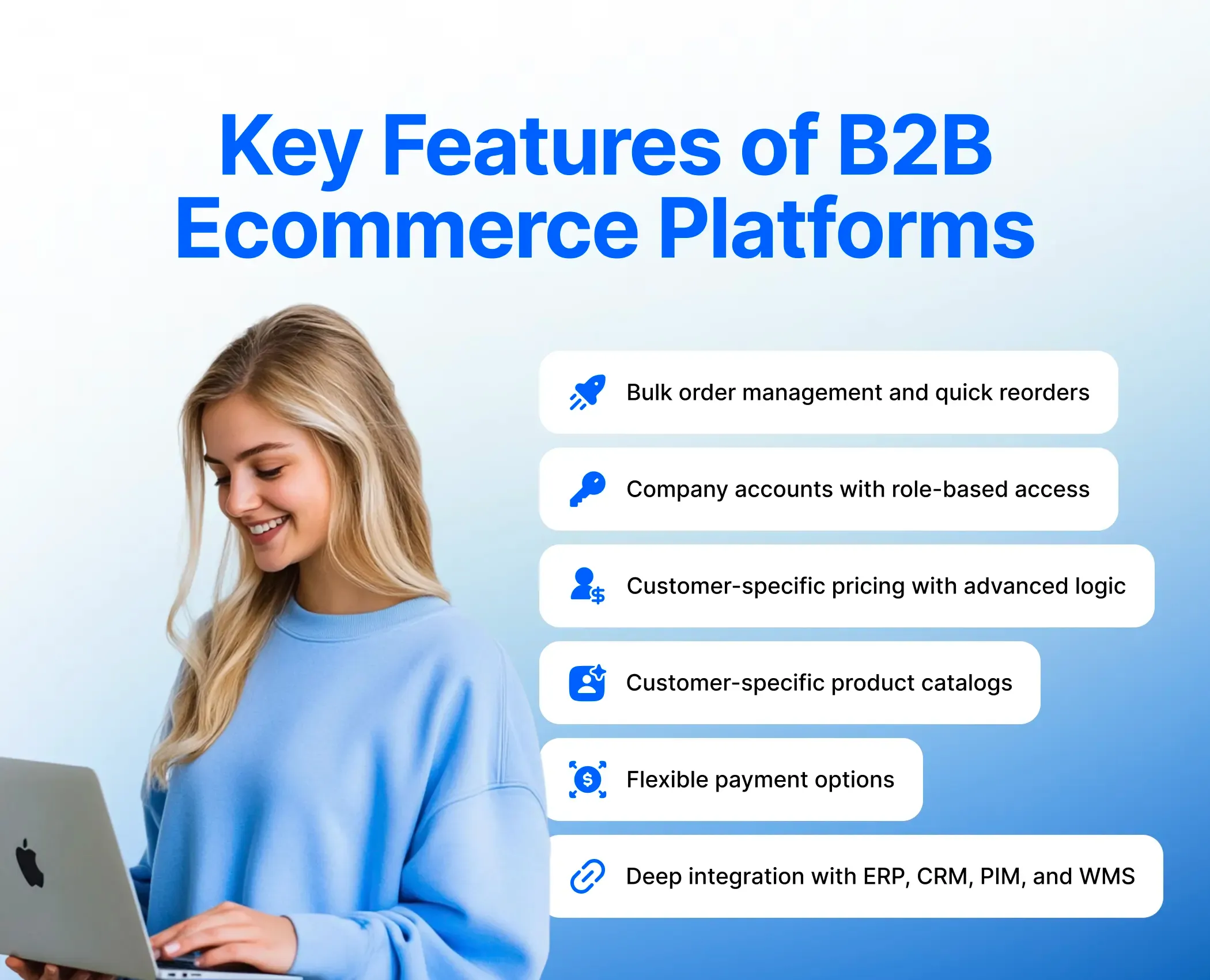
Bulk order management and quick reorders
Mostly, B2B buyers place large orders and frequently need to reorder the same list of products.
For this reason, B2B platforms typically allow:
Upload CSV and Excel files with a lot of items
Save order templates and favorites
Reorder from previous invoices and orders
Company accounts with role-based access
Instead of accounts for individual customers, B2B platforms have company accounts that include complex hierarchies for different departments with various roles and permissions.
Which capabilities are typically included?
Role-based visibility of pricing, order history, and budgets
Purchasing limits for different departments
Roles of administrators, finance users, buyers, and approvers
Customer-specific pricing with advanced logic
B2B engines let you handle much more complex pricing strategies than just discounts.
What could be in the package?
Currency- and region-specific pricing rules
Time-based pricing and promotional timeframes
Volume and tiered pricing
Contract pricing by customer or segment
Customer-specific product catalogs
With a B2B platform, you can control which products each customer or group can see and buy. The catalogs can be tailored to location, customer preferences, restrictions, and more, giving you a smoother validation process and more opportunities for personalization.
Which capabilities could be included?
Catalog segmentation by account and region
Restricted SKUs for regulated items
Product bundles by customer segment
Flexible payment options
B2B relationships require more flexibility in payment than B2C, going beyond a one-time purchase at checkout.
Which options are typically available?
Mixed payment models, such as online payment and invoice
Net payment during 30, 60, or 90 days
Credit limits based on past payment history
Deep integration with ERP, CRM, PIM, and WMS
To ensure a consistent customer experience and reduce errors, B2B commerce platforms are designed to be fully integrated into larger enterprise systems.
What capabilities are included?
Customer data exchange with Customer Relationship Management (CRM)
Real-time pricing and inventory sync with Enterprise Resource Planning (ERP)
Fulfillment and logistics sync via Warehouse Management System (WMS)
Product data sync via Product Information Management (PIM)
Best ecommerce platforms for B2B selling
Now, with the understanding of what to expect from B2B platforms, let's explore some of the most popular and powerful platforms available in the market today.
Shopify Plus
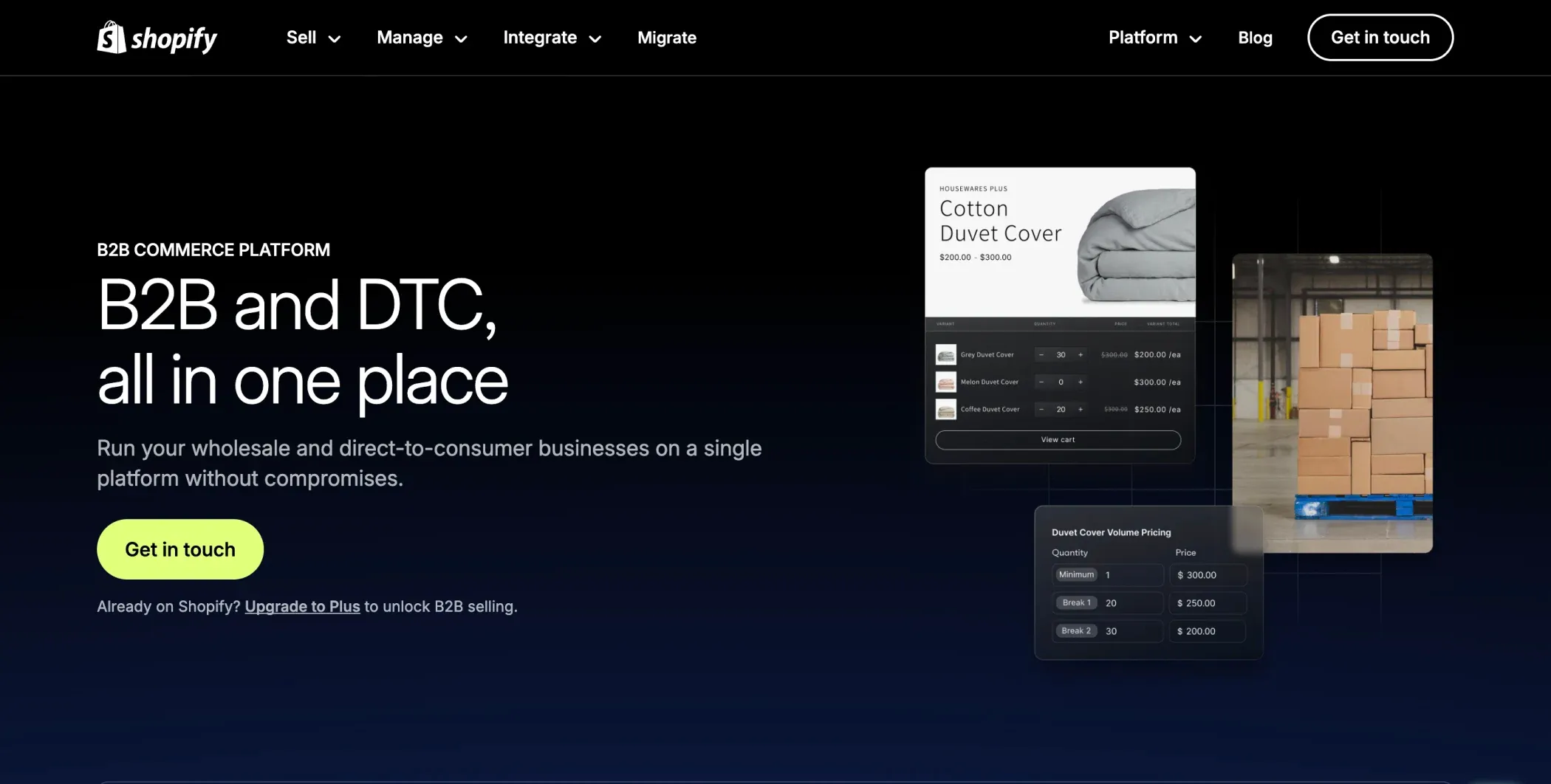
The Shopify platform, and specifically its Shopify Plus plan, is designed to run both B2C and B2B operations under one roof. It's among the best B2B ecommerce platforms since you can manage orders, customer accounts, and inventory, keeping consistent online, wholesale, and in-store data flows. Shopify offers a lot of out-of-the-box tools along with advanced customization options for businesses of different sizes.
Main B2B ecommerce features of Shopify Plus:
Company profiles with unique permissions, payment terms, and tax exemptions
Customer-specific catalogs assigned to a specific buyer or location
Quantity rules for products and variants to match wholesale buying patterns
Volume pricing that allows a lower unit cost for higher sales volume
Store personalization to show relevant content to customer segments
Sales rep permissions to place orders on the customer's behalf
Quick bulk ordering with a list of all products and variants
Flexible payment options with the ability to send invoices for payment
Easy reordering based on past purchases
Support of PayPal payments and vaulted credit cards
Custom discounts on top of wholesale prices
Individual self-checkout options for quick ordering
Self-serve returns and status tracking via customer accounts
On top of that, Shopify supports a headless approach, enabling Shopify headless development along with providing tools for workflow automation for more flexibility and efficiency across B2B processes. See the complete list of Shopify B2B features here. To find out how these features work for real-world businesses, check how the DigitalSuits' client Aquablu built their D2C and B2B store using Shopify capabilities and our Shopify Plus development and Shopify B2B development services.
Pricing: The Shopify Plus plan starts at $2,300 per month for standard setup and integration.
By the way, we offer you to read the article covering reasons to go for Shopify for your B2B business if Shopify is already on your B2B shortlist.
Adobe Commerce
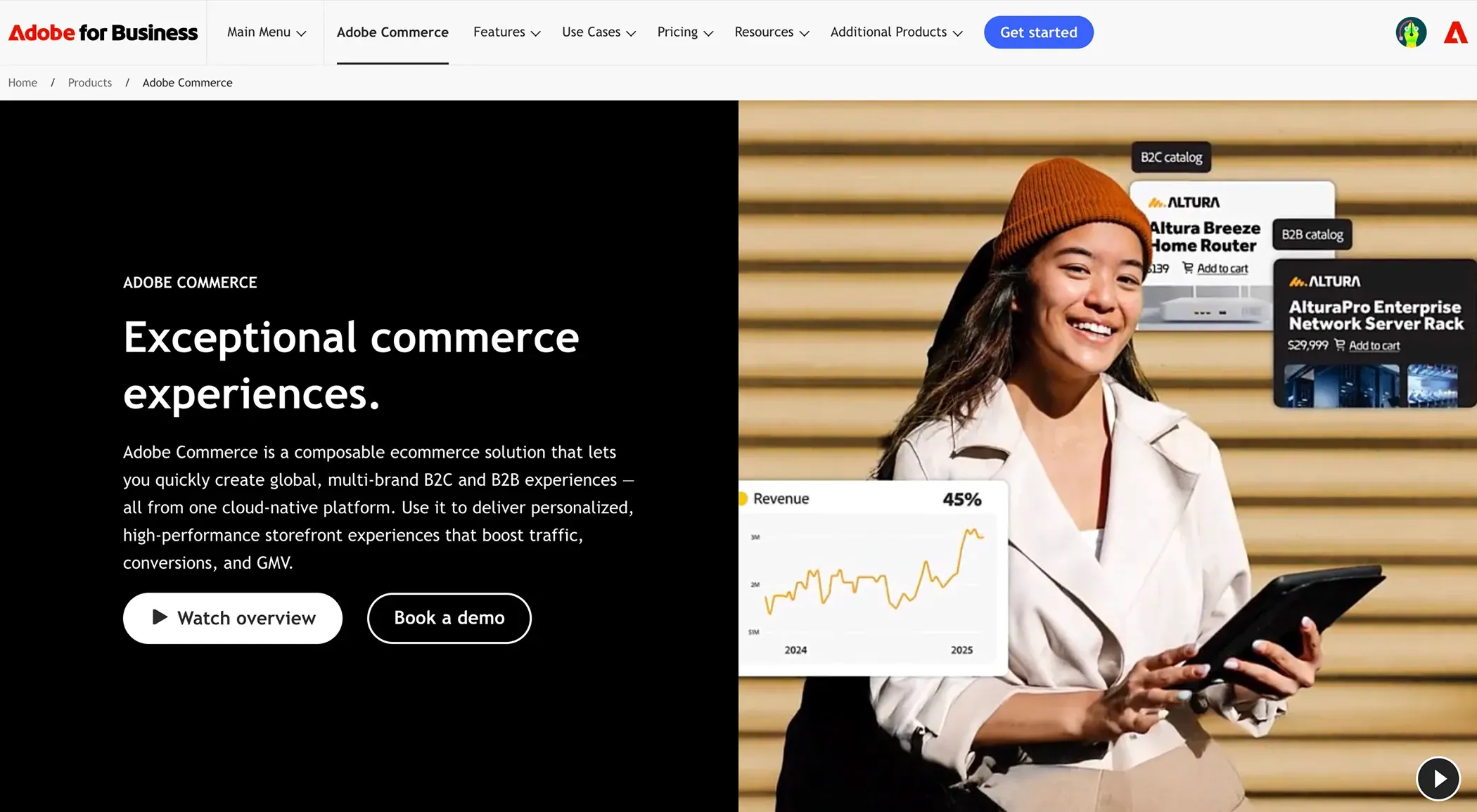
Adobe Commerce (formerly known as Magento) is a great choice for enterprise-level businesses that seek robust customization and control over all elements of their ecommerce system. The platform supports both B2B and B2C operations, so you can use it to run two models simultaneously with shared catalogs and marketing tools. However, it could require more effort and budget for development than with Shopify.
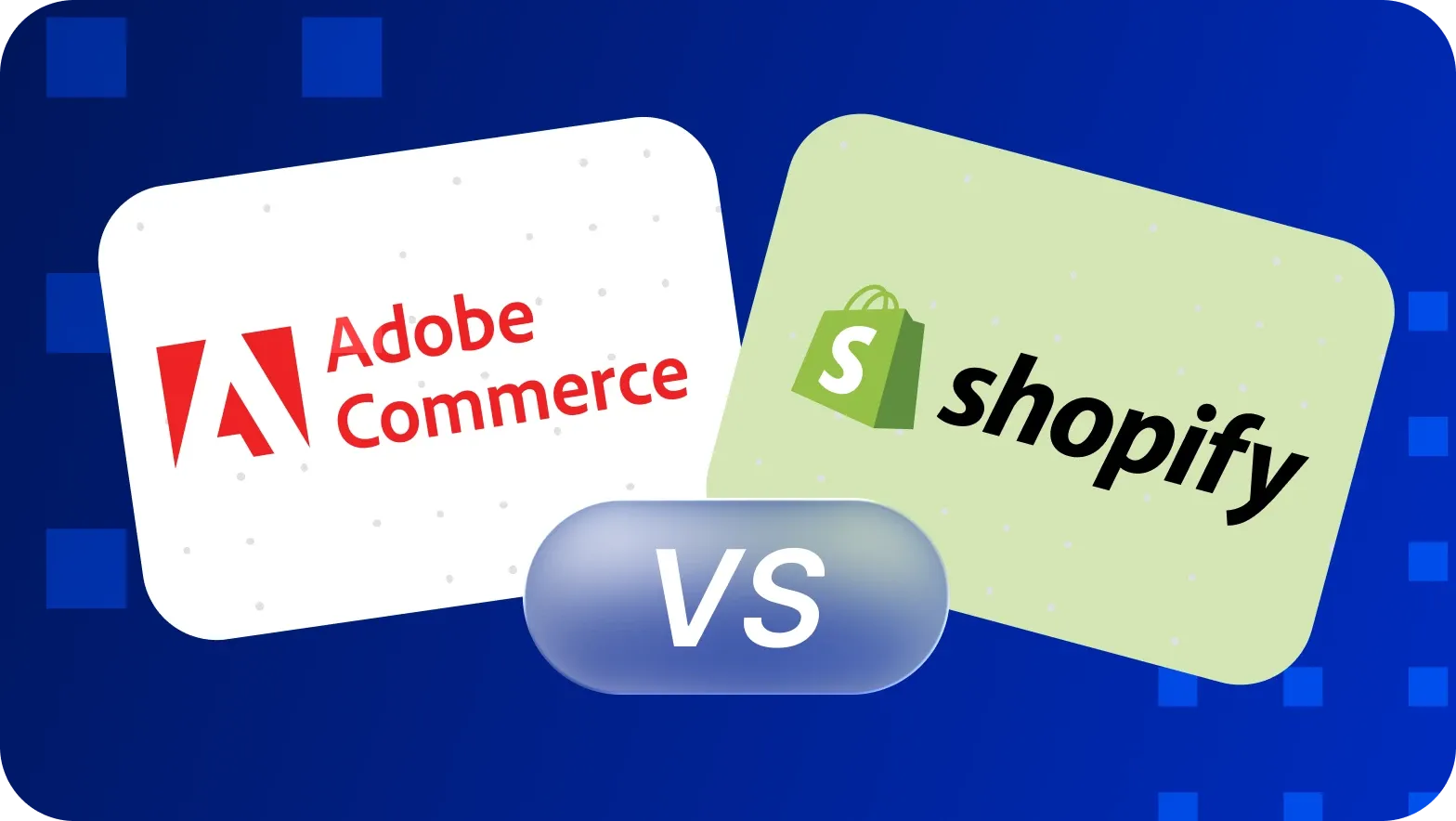
By the way, if – by chance – you are stuck trying to choose between Shopify and Adobe, our detailed B2B ecommerce platform comparison in the article Shopify vs. Adobe Commerce – Which is Better for B2B will come in handy.
Main B2B ecommerce features of Adobe Commerce:
Customer-specific price books and catalogs with available products for each buyer
Fast reordering via uploading multiple SKUs and recurring order lists
Company accounts with multiple buyers and regional divisions
Online quoting for negotiations and closing B2B deals
Self-service account management with order history, invoices, credit balance, and more
Custom pricing models, including tiered and volume pricing
Quick orders within several clicks
Different storefront experiences within the unified system
Requisition lists for frequently ordered items
Purchase order approvals with the required permission
Headless architecture support for a smooth experience across multiple devices
See the details about Adobe Commerce B2B features at the link.
Pricing: Adobe Commerce uses a tiered annual licensing fee that starts at $22,000/year.
BigCommerce B2B Edition
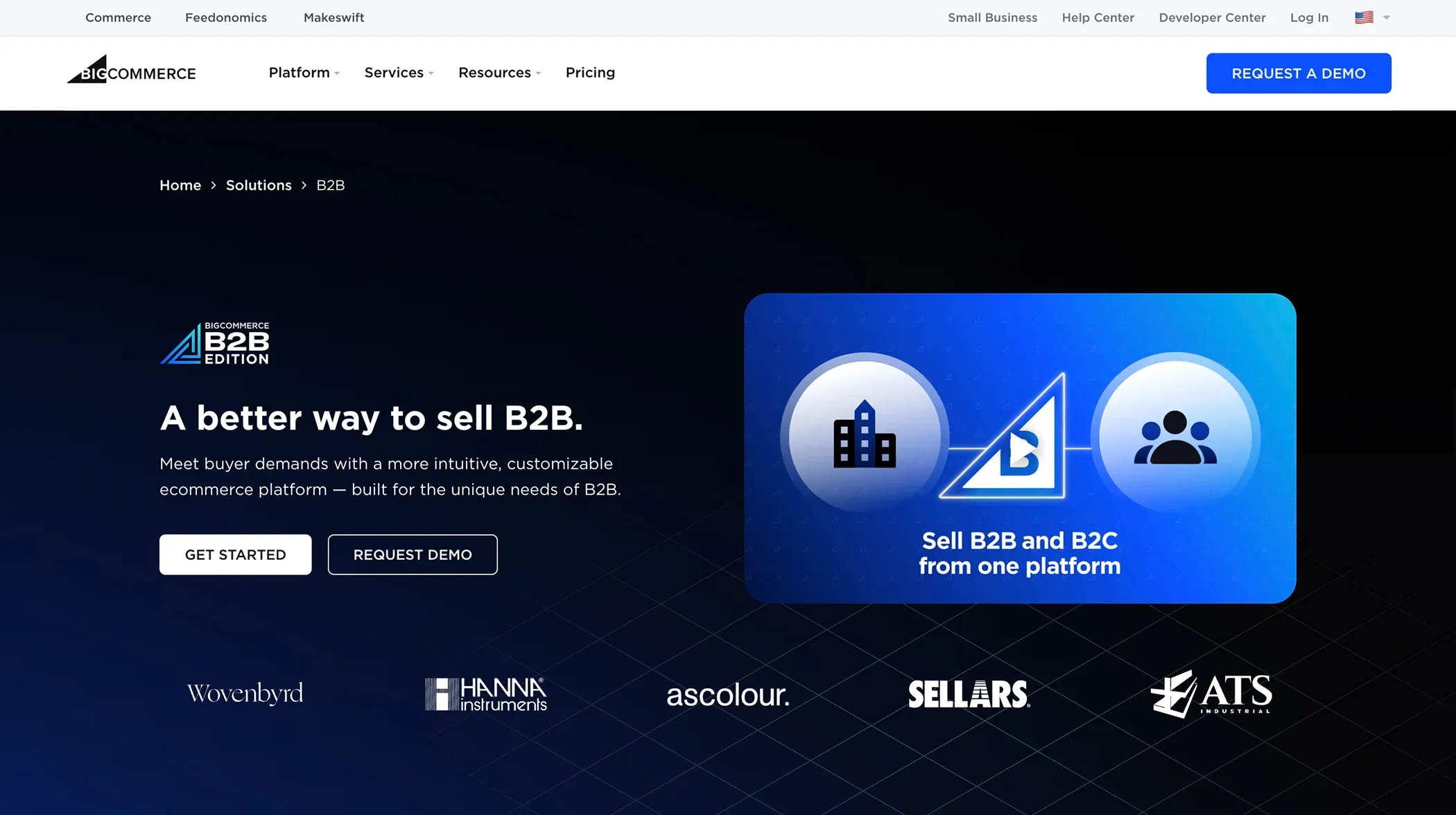
BigCommerce B2B Edition (formerly known as BundleB2B) is an add-on to the BigCommerce platform that lets businesses handle B2B sales with relevant features, such as custom pricing and custom accounts. BigCommerce provides advanced headless capabilities to build tailored shopping experiences. Check all the advantages of headless commerce if you thought about switching to it.
Main B2B ecommerce features of BigCommerce:
Open-source buyer portal for managing orders, invoices, and viewing history
Multi-user permissions and role-based access for approving workflows
Company account credit management
CSV upload for bulk ordering and quick order pads for fast SKU entry
Flexible payment terms, including quote-to-cash workflows
Volume discounts and custom pricing per customer segment
Multiple storefront locations support with the unified company accounts
Configure-price-quote (CPQ) functionality for custom product configuration
Shared shopping lists across team members
One-click reorders based on past purchases
Sales rep access for managing buyers' orders
Pricing: B2B features are available only on the Enterprise Bigcommerce plan, with custom pricing. You need to request a quote based on your business needs.
Interested in this platform? Discover how BigCommerce development services can benefit your business.
NetSuite Commerce
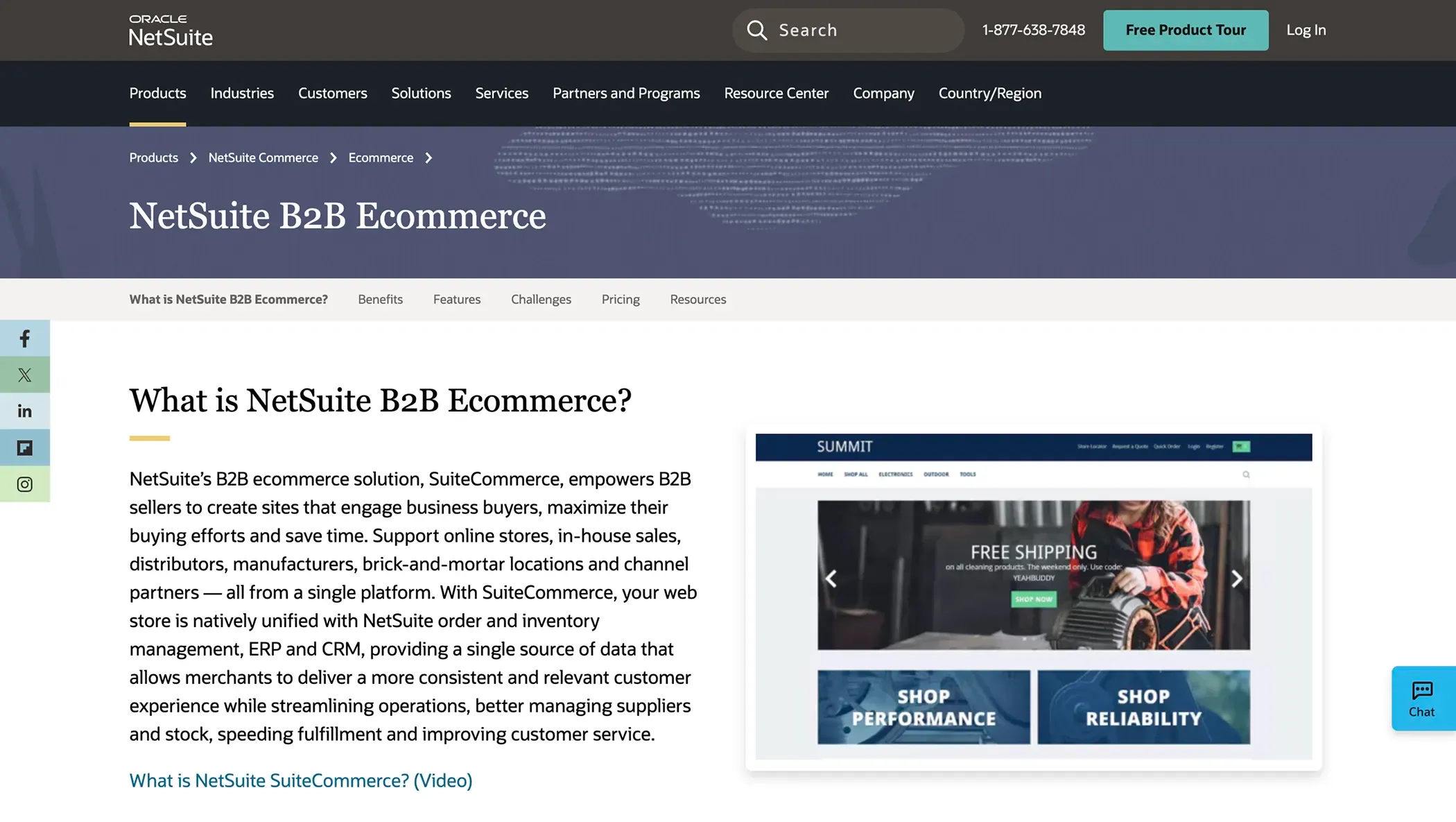
NetSuite Commerce is a part of the broader NetSuite platform that includes NetSuite ERP, so its B2B features are deeply integrated with the whole ecosystem and best suit businesses that prefer NetSuite’s products. The ecommerce platform supports both B2B and B2C selling and can also work with NetSuite's POS solutions, ensuring real-time inventory sync and smooth in-store operations.
Main B2B ecommerce features of NetSuite Commerce:
Self-service buyer accounts to manage orders and payments
Saved lists and one-click repeat orders
Bulk ordering with SKU lists and CSV uploads
Online quotes and quote-to-order flows
Tailored catalogs based on location, customer segment, and order history
Access-restricted sites with the parts protected with a password
Custom pricing, including volume-based and contract options
Personalized product recommendations
Support for credit limits and negotiated payment terms
Native integration with NetSuite ERP, CRM, SuiteAnalytics, and more NetSuite services
Pricing: NetSuite doesn't provide fixed prices; it offers a custom approach based on business size, number of users, and more.
Salesforce B2B Commerce Cloud
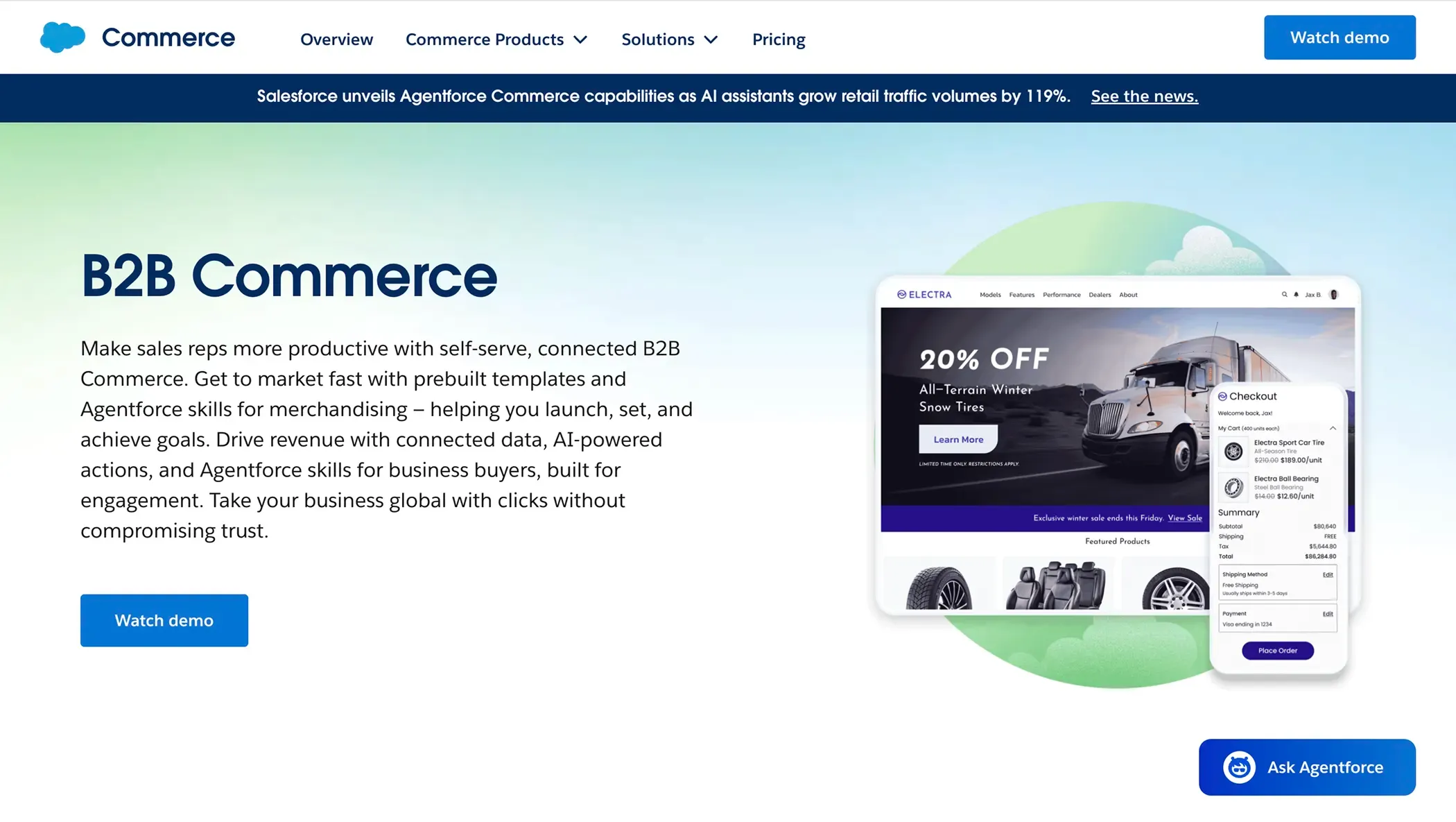
Salesforce B2B Commerce Cloud, aka Agentforce Commerce, is a solution built on top of the Salesforce Cloud ecosystem, combining powerful CRM and AI tools. This platform best suits enterprise-level businesses with global scale and multi-layered buying processes, especially those that already use Salesforce products.
Main features of Salesforce B2B Commerce:
Multi-tier corporate accounts with roles for approving, managing, and purchasing
Multi-step approval workflows for complex hierarchies
Large-volume order support with order management automation
Negotiated pricing workflows and quote-to-order options
End-to-end order tracking and AI-powered analytics
AI-driven product recommendations and promotions
Multi-store management within a single dashboard
Order splitting for large orders and multi‑location fulfillment
Headless commerce support with APIs for cart, checkout, and more
Native integration with Salesforce Sales, Service and Marketing Cloud, and Customer 360 CRM
Pricing: There are no fixed prices for a B2B platform. You need to contact the Salesforce team for custom pricing based on your sales volume.
Need our help to make the right choice?
In addition to the most popular wholesale ecommerce platforms we described in our article, you might also consider other options, such as OroCommerce, nopCommerce, or Shopware. If you're struggling with making a decision, our DigitalSuits team can help you choose between the best B2B platforms based on your needs and ensure successful B2B operations.
We have proven knowledge in building reliable solutions gained through years of ecommerce development. We will help you create an implementation plan, select the right technologies, set up your B2B store, integrate it with your business ecosystem, and configure every element in line with your goals and workflows. Our team ensures custom integrations, so whichever CRM or ERP you're using at the moment, we make everything work as a whole with your preferred B2B ecommerce system.
Check our case study that reveals the process of integrating the Odoo ERP with the medical equipment Shopify store. If you need this kind of solution or even more tailored features, don't hesitate to contact us for an initial consultation and long-term growth.
Frequently asked questions
What are the typical pricing models for B2B ecommerce platforms, and how do they work?
B2B ecommerce platforms typically offer tiered or customized pricing models. Here are the most common approaches:
Subscription-based model with a monthly or annual fee for using the platform, such as on Shopify.
Gross Merchandise Value (GMV) pricing model typically charges some percentage of the sales processes through the platform.
One-time licensing may require a setup fee along with the annual subscription fee for the platform usage.
Add-on costs may arise for additional features you add to your store, such as premium support or AI capabilities.
Which B2B ecommerce platforms are the best for small and medium-sized businesses?
Top B2B ecommerce platforms for SMBs are Shopify Plus for its user-friendliness and flexibility, BigCommerce for its robust features and cost-effectiveness, and WooCommerce (with B2B plugins) for its affordability and customization options. If you're looking for a development team for your SMB to grow with B2B capabilities, don't hesitate to contact us.
How long does it take to implement a B2B ecommerce platform into a business infrastructure?
The implementation timelines depend on the project's complexity, the number of integrations, and the level of customization.
Standard B2B storefront setup with minimal customization may take around 4-12 weeks.
Fully customized storefront with advanced B2B features and deep integration will take up to 6-9 months to complete.
To estimate timelines for your project based on its specifics, contact the DigitalSuits team.

Written by
Anastasiia Moskvichova
Content Marketing Specialist
Anastasiia is an enthusiastic content writer who diligently researches and curates valuable information to craft engaging content tailored for readers with a keen interest in marketing, sales, and technology.






Was this helpful?
0
No comments yet